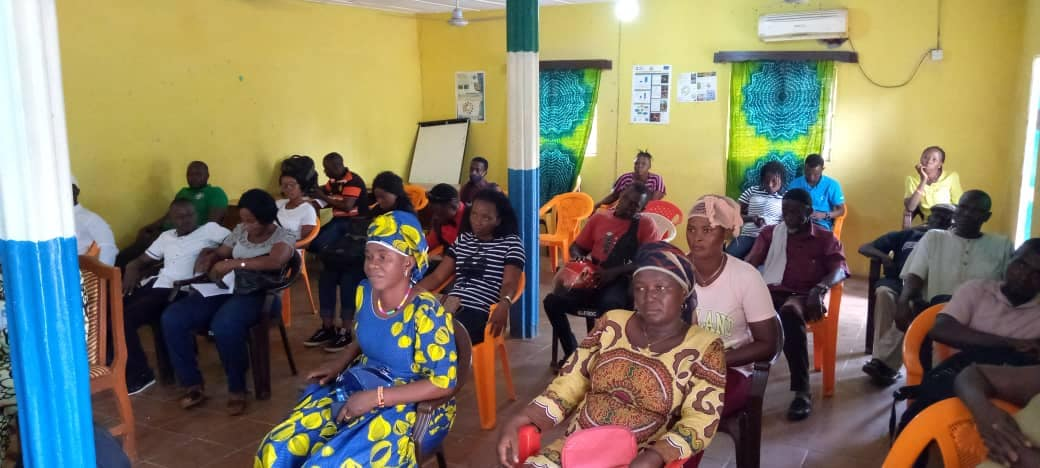

The Sierra Leone Chamber for Agribusiness Development (SLeCAD) undertook a series of district-level orientation and consultative engagements with the Ministry of Agriculture and Food Security (MAFS) and project offices under the BAFS, SCADeP, and AVDP programmes in Port Loko, Bombali, and Kono districts from 24 to 26 June 2020. The engagements formed part of ongoing efforts to strengthen coordination between government-led agricultural projects and private sector agribusiness actors at district level.
The meetings brought together District Agriculture Officers, project representatives, extension staff, SLeCAD leadership, district coordinators, and chamber members to align on the implementation of key agricultural value chains, particularly sorghum, sesame, and pigeon pea. Discussions focused on improving access to inputs, strengthening farmer capacity, and addressing long-standing challenges related to market access and price stability.
Across the three districts, SLeCAD presented its implementation approach under the BAFS and SCADeP projects, emphasizing the importance of moving farming communities beyond subsistence into commercially viable production systems. The engagements highlighted the need for coordinated planning, structured out-grower models, and closer collaboration between government institutions and organized agribusiness platforms to ensure sustainable outcomes.
A key focus of the discussions was the role of SLeCAD in facilitating market-oriented solutions. Through partnerships with input dealer companies and agribusiness stakeholders, the Chamber outlined plans to improve access to quality seeds, agro-inputs, and production knowledge while strengthening linkages between farmers and buyers. These interventions are designed to reduce production risks, improve yields, and increase income returns for farming households.
The engagements also underscored the importance of diversified and competitive markets. Lessons from previous value chain experiences, particularly around price volatility and buyer monopolies, reinforced the need for transparent pricing mechanisms and multiple market outlets. SLeCAD’s involvement positions the Chamber to support fairer market access by coordinating aggregation, linking producers to off-takers, and advocating for commercially attractive pricing structures.
For SLeCAD members, the district engagements signal concrete opportunities for participation across the value chain. Members operating as producers, aggregators, processors, input suppliers, transporters, and service providers are positioned to engage in structured out-grower schemes, input distribution networks, training programmes, and commodity aggregation initiatives. The identification and verification of out-growers across Port Loko, Bombali, and Kono further lays the groundwork for organized production and procurement arrangements that can be scaled over time.
The meetings also strengthened collaboration with District Agriculture Offices, which committed to supporting farmer identification, extension services, supervision, and coordination at community level. This collaboration enhances implementation efficiency and ensures that agribusiness interventions are aligned with national agricultural priorities and district development plans.
By engaging directly at district level, SLeCAD reinforces its role as a bridge between policy, projects, and market actors. The engagements support government objectives on food security, import substitution, employment creation, and private sector-led growth, while ensuring that agribusiness actors are meaningfully integrated into public investment programmes.
The outcomes of the district consultations include verified out-grower numbers across the three districts, strengthened institutional partnerships, and a clearer pathway for coordinated implementation of value chain activities. These engagements contribute to building a more resilient, market-driven agricultural sector where farmers and agribusinesses can participate competitively and sustainably.
SLeCAD remains committed to working with government, development partners, and its members to translate agricultural programmes into practical market opportunities that strengthen livelihoods, expand enterprise growth, and advance inclusive agribusiness development in Sierra Leone.